
The Complete Guide to the Tricare Pharmacy Program
Last Updated: July 2026 -
Important: Tricare pharmacy policies, covered medications, copayments, and pharmacy network participation may change over time. While we strive to keep this guide current, always verify your specific medication and coverage using the official Tricare and Express Scripts resources before making healthcare decisions.
If you've ever wondered why one prescription is covered while another isn't, why your medication suddenly requires a prior authorization, whether you should use a military pharmacy or your local pharmacy, or what to do if you're traveling overseas, you're not alone. Understanding your pharmacy benefits can be one of the most confusing parts of using Tricare.
The good news is that most people enrolled in Tricare have prescription drug coverage through the Tricare Pharmacy Program. Think of it as the prescription drug portion of your health insurance. Just like your medical benefits help pay for doctor visits, hospital care, and other healthcare services, your pharmacy benefits help pay for covered prescription medications. The Tricare Pharmacy Program also helps determine:
Which medications are covered
Where you can fill your prescriptions
Whether a medication needs additional approval before it's covered
What your out-of-pocket costs may be
While many pharmacy rules are the same across most Tricare health plans, there are important differences depending on your health plan, the type of medication you need, and whether you're in the United States or overseas. We'll explain those differences throughout this guide so you know what to expect before you get to the pharmacy.
Whether you're new to Tricare or you've been using it for years, our goal is to help you better understand your pharmacy benefits in plain English. We'll explain common insurance terms, answer frequently asked questions, and point you to official Tricare resources whenever you need more information.
Throughout this guide, you'll learn about:
How the Tricare Pharmacy Program works
How your Tricare health plan works with your pharmacy benefits
The different ways to fill your prescriptions
How to access your Tricare pharmacy information
Generic, brand-name, non-formulary, and non-covered medications
Prior authorizations, step therapy, and quantity limits
Specialty medications
Medicare Part B medications and Tricare For Life
GLP-1 medications
Pharmacy benefits while traveling or living overseas
Common pharmacy problems and how to solve them
TFLCI Tip: You don't need to memorize insurance terminology to understand your pharmacy benefits. Throughout this guide, we'll explain common Tricare terms in plain English and share practical tips based on the questions we hear most often from our community.
What Is the Tricare Pharmacy Program?
The Tricare Pharmacy Program is your prescription drug coverage. In simple terms, it's the part of Tricare that helps pay for covered prescription medications.
One thing that surprises many people is that your pharmacy coverage is the same no matter which Tricare health plan you have. Whether you're enrolled in Tricare Prime, Tricare Select, Tricare Reserve Select, Tricare Retired Reserve, Tricare Young Adult, or Tricare For Life, your prescription drug coverage generally follows the same pharmacy rules. The main exception is the US Family Health Plan (USFHP), which has its own pharmacy program.
The Tricare Pharmacy Program gives you several ways to fill your prescriptions, including military pharmacies, Tricare Pharmacy Home Delivery, retail network pharmacies, and, in some situations, non-network pharmacies. Later in this guide, we'll explain each option, when to use it, and how your costs may differ depending on where you fill your prescription.
Before we dive into the details, it's helpful to understand who manages the Tricare Pharmacy Program and why you may hear about a company called Express Scripts. We'll cover that next.
Does My Tricare Health Plan Matter?
This is one of the most common questions we receive, and the answer is: yes—and no.
Your Tricare health plan (such as Tricare Prime, Tricare Select, or Tricare For Life) determines how you receive your medical care. For example, it may determine whether you need a referral to see a specialist or how much you pay for certain medical services. Your pharmacy benefit works a little differently.
For most Tricare beneficiaries, prescription drug coverage is provided through the Tricare Pharmacy Program, regardless of which Tricare health plan they're enrolled in. That means many of the pharmacy rules, covered medications, and pharmacy options are the same whether you have Tricare Prime, Tricare Select, Tricare Reserve Select, Tricare Retired Reserve, Tricare Young Adult, or Tricare For Life.
The biggest exception is the US Family Health Plan (USFHP). If you're enrolled in USFHP, your prescription drug coverage is provided through your USFHP plan instead of the standard Tricare Pharmacy Program. Because of that, some of the information in this guide may not apply to you. Don't worry if this still feels a little confusing. Throughout this guide, we'll point out any important differences between Tricare health plans whenever they affect your pharmacy benefits.
TFLCI Tip: Think of your Tricare health plan and your pharmacy benefit as two pieces of the same puzzle. Your health plan helps determine how you receive your medical care, while the Tricare Pharmacy Program helps determine how you receive your covered prescription medications. Although they work together, they don't always follow the same rules.
Where Can I Fill My Prescriptions?
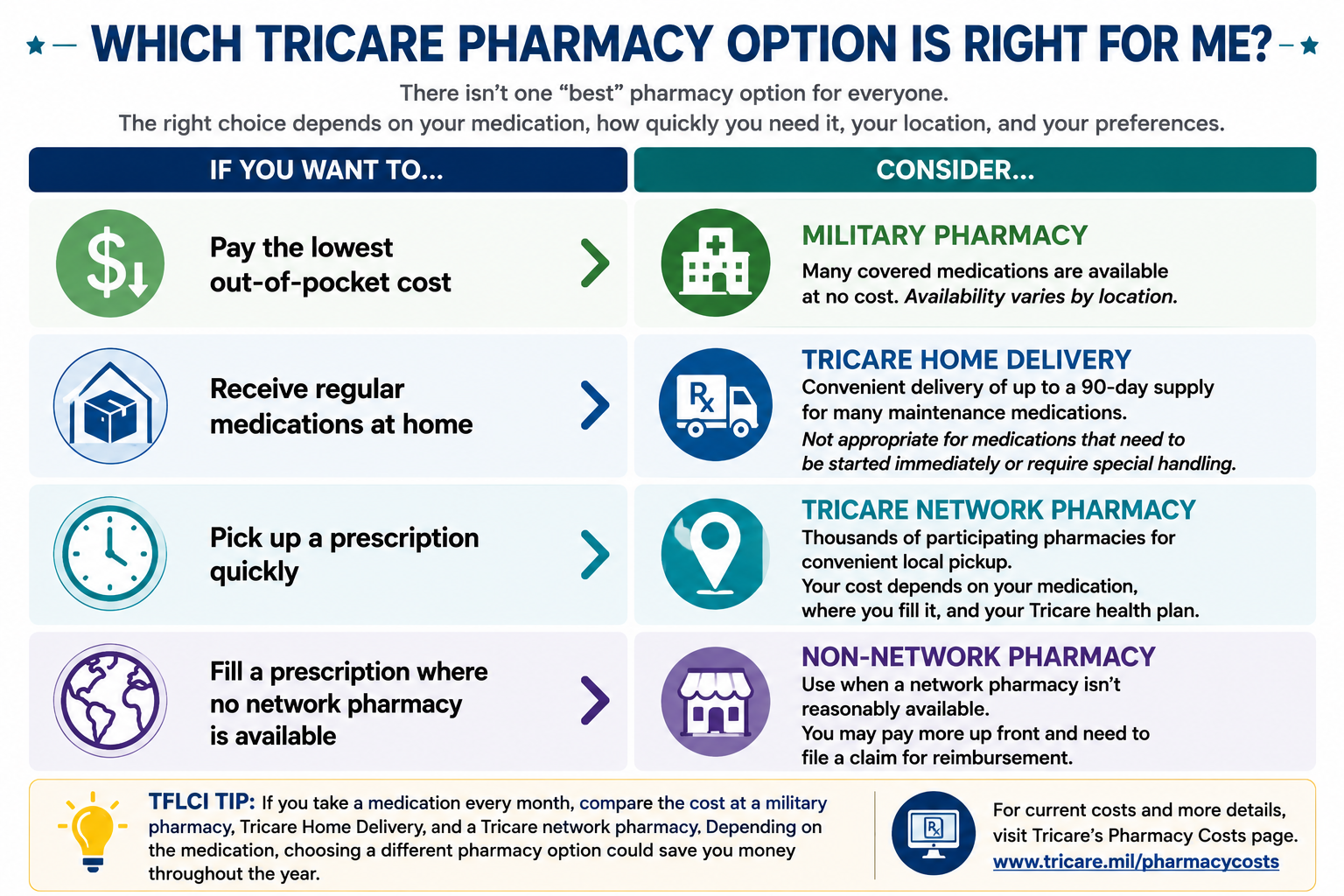
The Tricare Pharmacy Program offers four ways to fill covered prescription medications. The best option for you depends on the type of medication you need, how quickly you need it, where you live, and whether you're traveling. Throughout this guide, we'll take a closer look at each option, including costs, coverage, and when each one may be the best choice.
1. Military Pharmacies
Military pharmacies are located at military hospitals and clinics (also called military treatment facilities or MTFs). If your medication is available, this is the lowest out-of-pocket cost option, as many covered formulary medications are available at no cost to eligible beneficiaries. Availability varies by location, so it's always a good idea to check with your local military pharmacy before making the trip.
Best for:
Routine prescriptions
Maintenance medications (medications you take on an ongoing basis for chronic conditions, such as high blood pressure or thyroid disease).
Saving money when your medication is available
2. Tricare Pharmacy Home Delivery
Home Delivery allows many maintenance medications to be shipped directly to your home through the Tricare Pharmacy Program. This option is especially convenient for medications you take regularly, such as blood pressure, cholesterol, asthma, COPD, osteoporosis, seizure disorders, or thyroid medications. Depending on the medication, you may receive up to a 90-day supply.
Best for:
Long-term maintenance medications
Convenience
Potential savings over monthly retail fills
3. Tricare Network Pharmacies
Tricare has a nationwide network of retail pharmacies that have agreed to participate in the Tricare Pharmacy Program. These participating pharmacies are called network pharmacies. This is often the best choice when you need a medication quickly or prefer to pick it up in person. Most beneficiaries use a network pharmacy at some point, whether it's a large chain or a participating local pharmacy.
Best for:
New prescriptions
Short-term medications
Immediate pickup
A Quick Note About Certain Maintenance Medications
One area that often causes confusion is Tricare's Maintenance Medication Program. While many maintenance medications can be filled at military pharmacies, through Tricare Pharmacy Home Delivery, or at Tricare network retail pharmacies, certain maintenance medications have additional rules.
If a medication is included in the Maintenance Medication Program, you may only be able to receive a limited number of fills at a Tricare network retail pharmacy before you'll need to switch to Tricare Pharmacy Home Delivery or a military pharmacy (if your medication is available there) to continue receiving coverage.
Not every maintenance medication is part of this program. If you take a medication on a long-term basis, it's a good idea to verify whether your medication is included rather than assuming the rule applies to every maintenance medication.
How to Check
You can check your medication using the Tricare Formulary Search Tool.
Search for your medication.
Enter your age and sex.
Select your medication from the search results.
Click View Retail Coverage.
If your medication is part of the Maintenance Medication Program, you may see a notice similar to the example below:
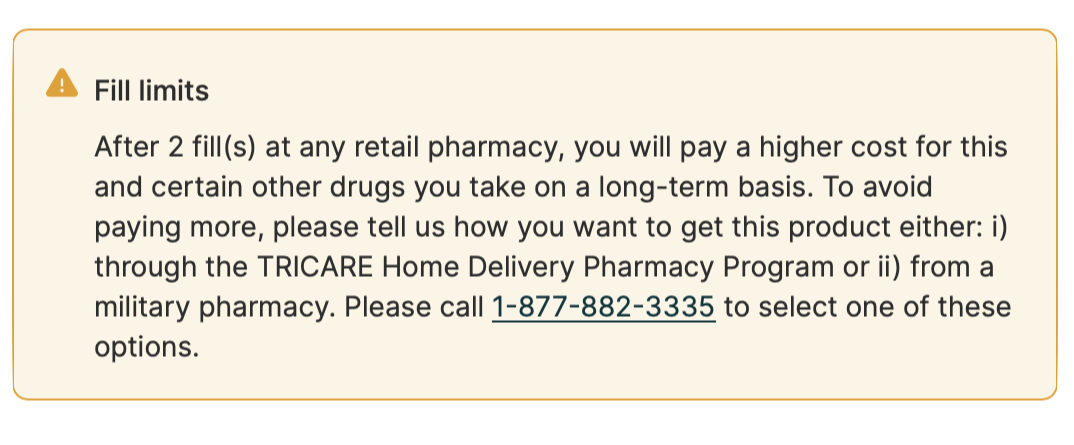
Example of a Maintenance Medication Program notice displayed in the Express Scripts Formulary Search Tool (captured August 2026). The wording and appearance may change as Express Scripts updates its website.
TFLCI Tip: We frequently see beneficiaries told that all maintenance medications must be filled through Home Delivery. That's a common misconception. Only certain maintenance medications are part of the Maintenance Medication Program. Checking your medication in the Formulary Search Tool is one of the easiest ways to determine whether these additional rules apply.
4. Non-Network Pharmacies
If you use a pharmacy that isn't part of the Tricare network, you may have higher out-of-pocket costs and may need to submit a claim for reimbursement. A claim is a request for Tricare to reimburse you for covered healthcare or pharmacy expenses you've already paid. Reimbursement simply means Tricare pays you back for eligible expenses after you've paid the pharmacy yourself. In some situations—especially while traveling or living overseas—a non-network pharmacy may be your only option. We'll explain how reimbursement works later in this guide.
There isn't one "best" pharmacy option for everyone. The right choice depends on your medication, how quickly you need it, your location, and your personal preferences. For many maintenance medications, Tricare Home Delivery can provide additional convenience, while military pharmacies often offer the lowest out-of-pocket costs when your medication is available.
Best for:
Situations where no network pharmacy is reasonably available
TFLCI Tip: Not every pharmacy participates in the Tricare network, and participation can change over time. Before filling a new prescription, it's worth taking a minute to confirm that your pharmacy is still in-network. It could save you money and help you avoid unexpected surprises.
Understanding Pharmacy Costs
Your out-of-pocket costs depend on several factors, including:
Whether the medication is generic, brand-name, or non-formulary.
Your Tricare health plan (for example, some health plans have different pharmacy copayments than others).
Whether you're using a military pharmacy, Tricare Home Delivery, a network pharmacy, or a non-network pharmacy.
Because Tricare updates pharmacy copayments periodically, we've chosen not to include a table that may become outdated. Instead, we recommend reviewing Tricare's official Pharmacy Costs page for the most current copayments and cost information.
TFLCI Tip: If you take a medication every month, compare the cost at a military pharmacy, Tricare Home Delivery, and a network pharmacy. Depending on the medication, choosing a different pharmacy option could save you money throughout the year.
Accessing Your Tricare Pharmacy Information
You may be used to showing a separate insurance card when you visit a civilian pharmacy. Tricare works a little differently. Tricare does not issue a separate physical Tricare insurance card. Instead, your military ID card serves as proof that you're eligible for Tricare benefits.
Depending on who you are, your military ID may be:
A Common Access Card, commonly called a CAC, for an active-duty service member.
A Uniformed Services ID card, commonly called a USID card, for many military retirees and eligible family members.
When filling a prescription at a Tricare network pharmacy, present the military ID card for the person whose prescription is being filled. The pharmacy can use the identification information connected to your Defense Enrollment Eligibility Reporting System (DEERS) record to verify your Tricare pharmacy eligibility. DEERS is the military database that confirms your eligibility for Tricare and other military benefits.
Is There a Separate Tricare Pharmacy Card?
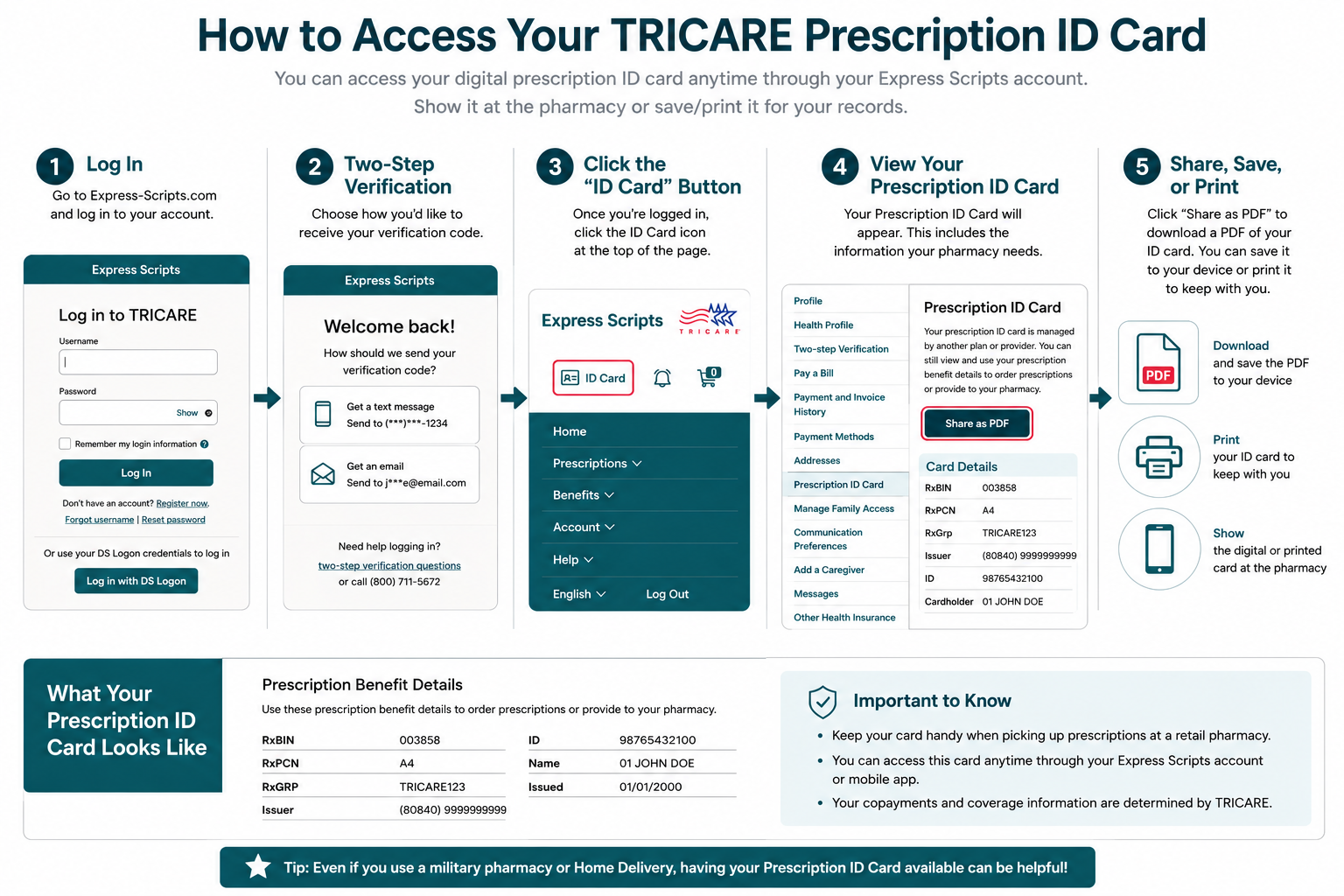
You do not need a separate pharmacy card to use your Tricare pharmacy benefit. Your valid military ID card is sufficient. However, Express Scripts also provides access to a prescription ID card through your online account or mobile app. This card includes the pharmacy billing information pharmacies use to process your prescription claims. The Express Scripts prescription ID card does not replace your military ID or establish your Tricare eligibility. Instead, it can serve as a helpful backup if a pharmacy has difficulty finding or processing your Tricare pharmacy coverage.
How to Access Your Prescription ID Card
Sign in to your Express Scripts account online or through the Express Scripts Pharmacy mobile app.
The exact wording or location of this option may vary depending on whether you're using the website or mobile app, and Express Scripts may update its menus from time to time.
From there, you will be able to:
View your prescription ID card.
Download or print a copy.
Save it to your phone or digital wallet.
Show your prescription ID card to the pharmacy if needed.
You can also use your Express Scripts account to refill prescriptions, track Home Delivery orders, check medication coverage, and review prior authorization requirements.
When Might the Express Scripts Card Be Helpful?
Although you may never need to show it, keeping the Express Scripts prescription ID card available can be useful when:
You're filling a prescription at a new pharmacy.
A pharmacy asks for your prescription insurance card.
Pharmacy staff can't immediately locate your Tricare pharmacy benefit.
The pharmacy needs the billing information used to submit the prescription claim.
You're traveling and want easy access to your pharmacy information.
If the pharmacy still can't process your prescription, ask whether it received a specific rejection message. You or the pharmacy may then need to contact Express Scripts for help determining whether the issue involves your eligibility information, the pharmacy network, the medication's coverage requirements, or how the claim was entered.
TFLCI Tip: Create your Express Scripts account and save the prescription ID card to your phone before you need it. Your military ID card is generally what you need to use your Tricare pharmacy benefit, but the Express Scripts card presents the billing information in a format many civilian pharmacies recognize. Having both available may make it easier to resolve a processing problem.
Understanding the Tricare Formulary
One of the most important terms you'll come across when using your pharmacy benefits is the Tricare Formulary, which is simply the list of prescription medications covered by Tricare. A formulary is a list of prescription medications that are covered by your health insurance plan. It helps determine which medications are covered, how they're covered, and whether any special requirements apply before you can receive them. The Tricare Formulary is developed using clinical evidence, safety information, and cost considerations. As new medications become available and new research is published, the formulary is reviewed and updated regularly. That means a medication's coverage can change over time.
Not every covered medication is treated the same. Each medication is placed into one of four coverage categories, and that category helps determine things like:
Whether the medication is covered.
Whether you need a prior authorization.
Whether you must try another medication first (step therapy).
Whether quantity limits apply.
Your pharmacy copayment.
Your total out-of-pocket cost also depends on where you fill your prescription, such as a military pharmacy, Tricare Home Delivery, a network pharmacy, or a non-network pharmacy. Because Tricare updates pharmacy copayments periodically, we've chosen not to include a chart that may become outdated. Instead, we recommend reviewing Tricare's official Pharmacy Costs page for the most current copayments and cost information.
The Four Coverage Categories
Generic Formulary Drugs
Generic medications contain the same active ingredients as their brand-name counterparts and are held to the same safety and effectiveness standards by the U.S. Food and Drug Administration (FDA). They are generally the lowest-cost covered option when available.
Brand-Name Formulary Drugs
These are brand-name medications that are included on the Tricare Formulary. They are covered, but they may cost more than generic medications depending on where you fill your prescription.
Non-Formulary Drugs
These medications aren't one of Tricare's preferred covered medications. They may still be covered when medically necessary, but they often have higher costs and may require additional approval before coverage is authorized.
Non-Covered Drugs
Some medications aren't covered by the Tricare Pharmacy Program. If a medication is classified as non-covered, you'll generally be responsible for the full cost unless another source of coverage applies.
TFLCI Tip: If your pharmacy tells you a medication "isn't covered," don't panic. Sometimes they really mean it isn't covered without additional approval. Before assuming you'll have to pay out of pocket, ask whether a prior authorization or another coverage requirement may apply.
What Is a Prior Authorization?
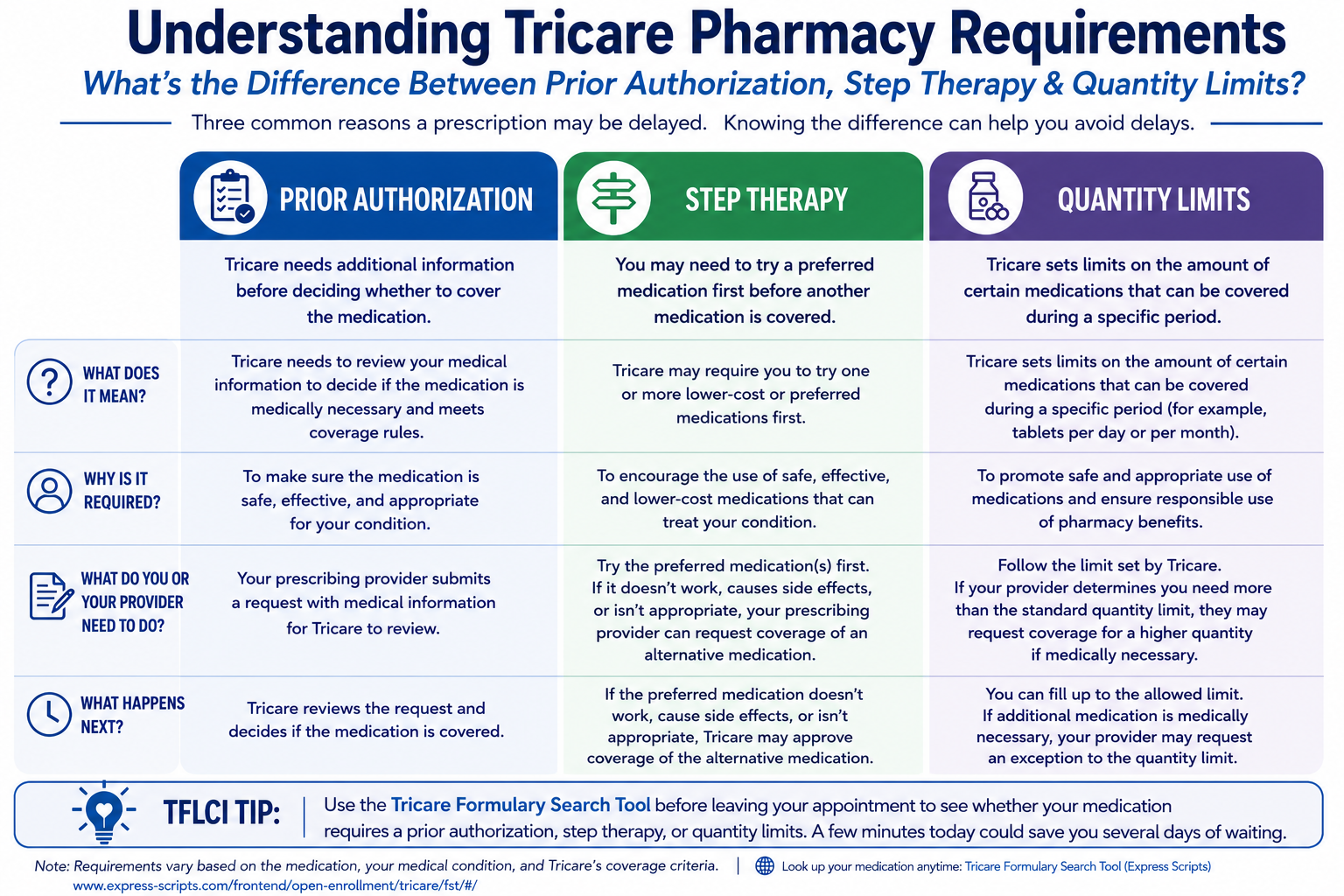
One of the most common reasons a prescription is delayed is because it requires a prior authorization.
A prior authorization (sometimes called a PA) is an approval process that takes place before Tricare agrees to cover certain medications. As part of that process, Tricare sometimes asks your healthcare provider to explain why the medication is medically necessary. Throughout this guide, we'll use the term healthcare provider to include physicians, nurse practitioners, physician assistants, and other licensed professionals who prescribe medications. It doesn't necessarily mean your medication has been denied—it simply means Tricare needs additional information to determine whether the medication meets its coverage requirements.
In most cases, your healthcare provider submits the prior authorization request on your behalf. The request may include information about your diagnosis, medical history, previous treatments you've tried, and why the medication is medically necessary.
Why Do Some Medications Require a Prior Authorization?
Not every medication requires a prior authorization. Tricare may require one for medications that:
Have specific safety concerns.
Require close monitoring.
Have lower-cost alternatives that may be appropriate.
Are approved only for certain medical conditions.
Have special coverage requirements established by the Tricare Pharmacy Program.
Prior authorizations help ensure medications are being used safely, effectively, and according to Tricare's coverage policies.
How Will I Know if My Medication Requires One?
If your medication requires a prior authorization, your pharmacy will usually let you know when they try to process your prescription. Your healthcare provider may also know ahead of time and submit the request before sending your prescription to the pharmacy, which can help avoid delays. If a prior authorization is needed, it's generally best to contact your prescribing provider's office. They can confirm whether the request has been submitted and whether any additional information is needed.
Can I Check if My Medication Requires a Prior Authorization?
Yes. In many cases, you can find out before you leave your healthcare provider's office whether your medication requires a prior authorization. If your provider is prescribing a new medication, ask during your appointment whether it requires a prior authorization through Tricare. If it does, ask if they can submit the request promptly. Taking care of it before you leave the office may help prevent delays once your prescription reaches the pharmacy.
You can also look up your medication yourself using the Tricare Formulary Search Tool. The Tricare Formulary Search Tool is an online tool that lets you look up prescription medications to see whether they're covered, whether they require a prior authorization, step therapy, or quantity limits, and what your estimated copayment may be.
If you're already at the pharmacy, your pharmacist can usually tell you if a prior authorization is required when they process your prescription. However, waiting until then may delay the start of your medication while your healthcare provider completes the required paperwork.
TFLCI Tip: Before leaving your appointment, ask your provider, "Does this medication require a prior authorization with Tricare?" If the answer is yes, ask if they can submit it before you leave the office. It's also a good idea to look up the medication yourself using the Tricare Formulary Search Tool while you're still at your appointment. Even the best healthcare providers may not know every Tricare pharmacy requirement, and a few extra minutes could save you several days of waiting later.
What Is Step Therapy?
Some medications require step therapy before Tricare will cover them. Step therapy is a coverage requirement that means you may need to try one or more preferred or lower-cost medications first before Tricare will cover a different medication. If those medications don't work, cause side effects, or aren't appropriate for your medical condition, your healthcare provider can request coverage for an alternative medication. The goal of step therapy is to ensure that safe, effective, and cost-effective treatment options are considered before more expensive medications are approved.
Why Does Tricare Require Step Therapy?
Tricare may require step therapy when:
A lower-cost medication has been shown to be effective for the same condition.
Clinical guidelines recommend trying one medication before another.
There are several medications available to treat the same condition.
Step therapy doesn't mean Tricare is denying your medication. It simply means there are additional coverage requirements that must be met before certain medications are approved.
Will I Always Have to Try Another Medication First?
No. If you've already tried the preferred medication and it didn't work, caused significant side effects, or isn't medically appropriate for your situation, your healthcare provider may be able to request an exception. Your provider may need to submit medical documentation explaining why the preferred medication isn't appropriate for you. Each request is reviewed individually based on Tricare's coverage criteria.
How Can I Find Out if My Medication Has Step Therapy Requirements?
Before leaving your appointment, you can use the Tricare Formulary Search Tool to see whether your medication has a step therapy requirement. This allows you and your healthcare provider to discuss any necessary documentation before your prescription is sent to the pharmacy. Your pharmacist can also tell you if step therapy applies when they process your prescription. However, finding out after you've arrived at the pharmacy may delay the start of your medication while your healthcare provider completes the required paperwork.
TFLCI Tip: If you've already taken another medication that didn't work or caused unwanted side effects, be sure to tell your healthcare provider. That information may help support a request for coverage of a different medication and could prevent unnecessary delays.
What Are Quantity Limits?
Some medications have quantity limits, which means Tricare limits how much of a medication it will cover during a certain period of time. For example, Tricare may limit how many tablets, capsules, injections, inhalers, or other doses you can receive each day or each month. These limits vary depending on the medication and Tricare's coverage criteria. Quantity limits don't necessarily mean you can't receive the medication. Instead, they help ensure medications are used safely and according to established clinical guidelines.
Why Does Tricare Have Quantity Limits?
Tricare may apply quantity limits to medications in order to:
Promote safe and appropriate medication use.
Help prevent accidental overuse or misuse.
Ensure medications are used according to approved dosing guidelines.
Support evidence-based prescribing practices.
Quantity limits are based on the medication, the condition being treated, and Tricare's coverage criteria.
What If I Need More Than the Quantity Limit?
If your healthcare provider determines that you medically need more than the standard quantity limit, they may request an exception on your behalf. Your provider may need to submit medical documentation explaining why a higher quantity is medically necessary. Tricare will review the request and determine whether additional coverage can be approved.
How Can I Find Out if My Medication Has a Quantity Limit?
Before leaving your appointment, you can use the Tricare Formulary Search Tool to see whether your medication has a quantity limit. The tool also lets you check for prior authorization requirements, step therapy requirements, coverage categories, and estimated copayments. Checking before your prescription is sent to the pharmacy gives you and your healthcare provider an opportunity to address any requirements that could delay your medication. If you're already at the pharmacy, your pharmacist can usually tell you if a quantity limit applies. However, if an exception is needed, your healthcare provider may need to submit additional information before Tricare can review the request.
TFLCI Tip: If your pharmacy tells you your insurance will only cover part of your prescription, ask whether you've reached a quantity limit. Sometimes the issue isn't that the medication isn't covered—it's simply that Tricare limits how much can be dispensed during a certain time period. If your provider believes you need more, they may be able to request an exception.
What Are Specialty Medications?
Some prescription medications are considered specialty medications because they require extra handling, monitoring, or support during treatment. These medications are often used to treat complex, chronic, or rare medical conditions such as certain cancers, multiple sclerosis, rheumatoid arthritis, psoriasis, hepatitis, and other specialized conditions. Specialty medications may require refrigeration, special packaging, special handling during shipping, careful monitoring for side effects, or ongoing support from a pharmacist or healthcare team.
How Are Specialty Medications Different?
Unlike many traditional prescription medications, specialty medications often:
Require special handling or storage.
Need ongoing monitoring by your healthcare provider.
May require a prior authorization before they're covered.
Can be expensive without insurance coverage.
May be shipped directly to your home or healthcare provider rather than picked up at a retail pharmacy.
Not every specialty medication has the same requirements. Coverage depends on the medication, your medical condition, and Tricare's coverage criteria.
How Do I Receive a Specialty Medication?
Many specialty medications are dispensed through Accredo, the specialty pharmacy used by the Tricare Pharmacy Program.
If your medication is handled by Accredo, you'll typically work directly with their specialty pharmacy team to:
Schedule medication deliveries.
Receive education about your medication.
Learn how to store and administer the medication (if applicable).
Coordinate refills and ongoing treatment.
Depending on the medication, it may be shipped to your home, your healthcare provider's office, or another approved location.
Will My Specialty Medication Require a Prior Authorization?
Many specialty medications do require a prior authorization before Tricare will cover them. Some may also have step therapy requirements or quantity limits, depending on the medication and its approved uses. Because these medications often have additional coverage requirements, it's a good idea to ask your healthcare provider's office whether any paperwork needs to be completed before your prescription is submitted.
How Can I Find Out if My Medication Is a Specialty Medication?
Your healthcare provider or pharmacist can usually tell you whether your medication is considered a specialty medication.
You can also use the Tricare Formulary Search Tool to review your medication's coverage information or contact Accredo Specialty Pharmacy if you've been referred there for treatment.
TFLCI Tip: Specialty medications often involve more coordination than a typical prescription. If you're prescribed one, don't wait until you're almost out of medication to request a refill. Starting the refill process early can help avoid interruptions in your treatment.
Special Pharmacy Situations
By now, you have a solid understanding of how the Tricare Pharmacy Program works, where you can fill your prescriptions, and some of the most common coverage requirements you may encounter. Most prescriptions are straightforward—you receive a prescription from your healthcare provider, fill it through the Tricare Pharmacy Program, and pay the applicable copayment.
However, some medications and situations follow different rules. Depending on the medication, where you receive it, how it's administered, or your Tricare health plan, there may be additional coverage requirements or different ways your prescription is processed. Understanding these special situations can help you avoid unexpected delays, unexpected costs, and confusion when filling your prescriptions.
In the following sections, we'll cover some of the most common special pharmacy situations that Tricare beneficiaries ask about, including:
Medications covered under Medicare Part B instead of the Tricare Pharmacy Program.
GLP-1 medications and why coverage requirements vary depending on the diagnosis and medication.
Vaccines and immunizations, including where they can be received and how they're covered.
Compound medications and when they're covered by Tricare.
Overseas prescriptions, including how to fill medications and submit pharmacy claims while traveling or living abroad.
Whether you're a new Tricare beneficiary or have been using your pharmacy benefits for years, understanding these unique situations can help you make informed decisions and better navigate your prescription drug coverage.
Understanding Medicare Part B Medications
If you have Tricare For Life (TFL), you may hear someone say that a medication is covered under Medicare Part Binstead of the Tricare Pharmacy Program. This can be confusing because both programs may cover prescription medications, but they don't always cover the same types of medications. In general, the Tricare Pharmacy Program covers medications that you typically pick up at a pharmacy or receive through Home Delivery. Medicare Part B, on the other hand, covers certain medications that are considered part of your medical care rather than your pharmacy benefit. These medications are often administered by a healthcare professional in a doctor's office, outpatient clinic, or hospital.
What Types of Medications Are Covered Under Medicare Part B?
Examples of medications that may be covered under Medicare Part B include:
Certain infused medications administered in a doctor's office or infusion center.
Some injectable medications given by a healthcare professional.
Certain chemotherapy medications.
Certain immunosuppressive medications for eligible transplant recipients.
Some osteoporosis medications that meet Medicare's coverage requirements.
Durable Medical Equipment (DME)-related drugs, such as medications administered through covered infusion pumps.
Coverage depends on the specific medication, how it's administered, your medical condition, and Medicare's coverage criteria.
Why Does This Matter?
Knowing whether a medication is covered under Medicare Part B or the Tricare Pharmacy Program helps you understand:
Which insurance is billed first.
Whether you'll pick up the medication from a pharmacy or receive it during a medical appointment.
Whether different coverage rules or costs may apply.
For most Medicare-covered medical services, Medicare pays first and Tricare For Life pays second for covered services. The same coordination generally applies to medications covered under Medicare Part B.
What If I'm Not Sure How My Medication Is Covered?
If you're unsure whether your medication is covered under Medicare Part B or the Tricare Pharmacy Program, ask your healthcare provider or pharmacist before your treatment begins. You can also review the medication using the Tricare Formulary Search Toolor contact Medicare or your regional Tricare contractor if you have questions about your specific situation.
TFLCI Tip: If your medication is being administered in your doctor's office, infusion center, or outpatient hospital, ask "Will this medication be billed under Medicare Part B or through my Tricare pharmacy benefit?" Knowing the answer ahead of time can help you understand how the claim will be processed and avoid unexpected billing questions later.
GLP-1 Medications
GLP-1 medications have received a great deal of attention in recent years because they're used to treat type 2 diabetesand, in some cases, obesity or weight management. Some of the most commonly prescribed GLP-1 medications include Ozempic®, Wegovy®, Mounjaro®, Zepbound®, Rybelsus®, and Trulicity®. Each medication has its own FDA-approved uses and Tricare coverage requirements.
One of the biggest misconceptions is that if Tricare covers one GLP-1 medication, it automatically covers all of them. That's not the case. Coverage depends on the specific medication, why it's being prescribed, your medical condition, and Tricare's coverage criteria.
Does Tricare Cover GLP-1 Medications?
Yes—but coverage depends on why the medication is being prescribed and which Tricare health plan you have.
For Type 2 Diabetes
Tricare continues to cover certain GLP-1 medications prescribed to treat type 2 diabetes when they are medically necessary and prior authorization requirements are met.
Examples may include medications such as:
Ozempic®
Mounjaro®
Trulicity®
Victoza®
Coverage is subject to Tricare's current clinical criteria and prior authorization requirements.
For Chronic Weight Management
In general, Tricare does not cover weight loss medications. However, beneficiaries enrolled in certain Tricare plans may qualify for coverage when all of the following requirements are met:
The medication is prescribed by a Tricare network provider.
It is medically necessary for your condition.
You meet Tricare's current prior authorization requirements.
You are enrolled in an eligible Tricare plan.
Eligible plans include:
Tricare Prime (including Prime Remote and Prime Overseas)
US Family Health Plan
Tricare Select (including Select Overseas)
Tricare Reserve Select
Tricare Retired Reserve
Tricare Young Adult
Continued Health Care Benefit Program (CHCBP)
Tricare For Life Beneficiaries
Beginning August 31, 2025, Tricare no longer covers GLP-1 medications prescribed solely for chronic weight management for Tricare For Life beneficiaries.
However, this change does not affect coverage of GLP-1 medications prescribed for type 2 diabetes. Those medications may still be covered when Tricare's medical necessity and prior authorization requirements are met.
Additionally, beginning July 1, 2026, Medicare Part D began covering certain weight loss medications through the Medicare GLP-1 Bridge Program for eligible beneficiaries enrolled in Medicare Part D. If you have Tricare For Life and questions about this program, review Medicare's current guidance or contact your Part D plan for more information.
How Can I Check My Coverage?
Before your appointment—or while you're still with your healthcare provider—use the Tricare Formulary Search Tool to look up your medication. You should also review Tricare's Weight Loss Products page if your medication is being prescribed for chronic weight management, as eligibility requirements and coverage policies can change.
TFLCI Tip: One of the most common questions we receive is whether Tricare covers medications like Wegovy® or Zepbound®. The answer depends on why the medication is being prescribed and which Tricare plan you have. Before your provider sends the prescription, check both the Tricare Formulary Search Tool and Tricare's Weight Loss Products page so you understand your current coverage and any prior authorization requirements.
Getting Prescriptions While Traveling or Living Overseas
Whether you're traveling for vacation, visiting family, or living overseas, planning ahead can help ensure you have the medications you need while you're away. How you obtain your prescriptions may depend on where you're traveling, how long you'll be away, and whether you're traveling within the United States or internationally.
Traveling Within the United States
If you're traveling within the U.S., you can generally fill prescriptions at any participating Tricare network pharmacy. If you'll be away for an extended period, you may also consider using Tricare Home Delivery to receive up to a 90-day supply of many maintenance medications before you leave. If you're traveling for longer than your current supply will last, you may be able to request a vacation override, which allows an early refill in certain situations. Vacation overrides aren't automatic and must meet Tricare's requirements.
Traveling Overseas
If you're traveling or living overseas, it's important to plan ahead before your trip.
Depending on where you're located, you may be able to:
Fill prescriptions at overseas military pharmacies, if available.
Purchase medications from an overseas pharmacy and submit a claim for reimbursement if eligible.
Use other options available through the Tricare Overseas Program.
Keep in mind that medication availability varies by country, and not every medication available in the United States is available overseas.
Before You Leave
Before traveling, consider taking these steps:
Make sure you have enough medication for your trip.
Check whether any of your medications require refrigeration or special handling.
Bring your medications in their original labeled containers.
Keep your medications in your carry-on luggage whenever possible rather than in checked baggage.
Verify whether your destination has any restrictions on bringing certain medications into the country.
Learn how to obtain medical care if you need a refill while you're away.
What If I Need a Refill While Traveling?
If you unexpectedly run out of medication while traveling, contact Express Scripts or your regional Tricare contractor as soon as possible. They can help explain your available options based on your location and Tricare plan.
TFLCI Tip: Don't wait until the week of your trip to refill your prescriptions. If you'll need an early refill because of travel, contact Express Scripts ahead of time to ask whether you qualify for a vacation override. Giving yourself extra time can help prevent last-minute problems.
Common Pharmacy Problems & How to Solve Them
Even when you understand how the Tricare Pharmacy Program works, you may occasionally run into issues. The good news is that many pharmacy problems have straightforward solutions once you know where to start. Here are some of the most common situations beneficiaries experience and what you can do next.
My Prescription Was Denied. Now What?
Seeing a prescription denied can be frustrating, but a denial doesn't always mean your medication isn't covered.
A prescription may be denied for several reasons, including:
A prior authorization is required.
Step therapy requirements haven't been met.
Quantity limits have been exceeded.
The medication isn't covered under the Tricare Formulary.
Your provider needs to submit additional medical documentation.
There was an issue processing the claim.
If your prescription is denied, ask your pharmacist or healthcare provider why it was denied before assuming the medication isn't covered. Your pharmacy doesn't decide what Tricare covers. The pharmacy simply processes the claim using Tricare's coverage rules.
My Pharmacy Says Tricare Won't Pay
Sometimes a pharmacy receives a rejected claim even though your medication is covered.
This may happen because:
Your information needs to be updated.
A prior authorization hasn't been approved yet.
The pharmacy needs additional information.
The medication requires additional review before it can be dispensed.
Ask the pharmacy for the specific rejection message or reason code, if available. That information can help your healthcare provider or Express Scripts identify the issue more quickly.
My Medication Requires a Prior Authorization
If your medication requires a prior authorization, your healthcare provider must submit documentation explaining why the medication is medically necessary. Processing times vary depending on the medication and the information provided. If you haven't heard anything after several days, you may want to contact your provider's office to confirm the request was submitted or check with Express Scripts for a status update.
My Medication Is Out of Stock
Medication shortages occasionally occur, especially with high-demand medications.
If your pharmacy doesn't have your medication:
Ask when they expect it to be available.
Ask whether another nearby network pharmacy has it in stock.
If appropriate, ask your healthcare provider whether an alternative medication may be suitable.
I Need My Medication Before I Travel
If you're traveling and need an early refill, you may qualify for a vacation override. Vacation overrides aren't automatic, so contact Express Scripts before your trip to learn whether you're eligible and what documentation, if any, is needed. Giving yourself plenty of time before you leave can help avoid last-minute delays.
I Accidentally Used a Non-Network Pharmacy
If you use a non-network pharmacy, you may pay more out of pocket than you would at a military pharmacy, Tricare Home Delivery, or a Tricare network pharmacy. Depending on your Tricare plan, you may also need to submit a claim for reimbursement. Review your Explanation of Benefits (EOB) and follow the claim instructions if reimbursement is available for your situation.
When Should I Contact Express Scripts?
Before calling Express Scripts, ask the pharmacy what message or rejection code they received when they tried to process your prescription. That information can often help you, your healthcare provider, or Express Scripts identify the problem much faster.
Express Scripts can often help if you have questions about:
Prescription claim issues.
Prior authorization status.
Pharmacy network questions.
Home Delivery.
Vacation overrides.
Pharmacy coverage requirements.
Pharmacy-related claims.
If your question involves your medical care or whether a medication is appropriate for you, contact your healthcare provider.
TFLCI Tip: When calling Express Scripts or speaking with your pharmacy, write down the date, the representative's name (if provided), and any reference or case number. Keeping a record of your conversations can make it much easier to follow up if additional assistance is needed.
-
Not always.
To receive the lowest out-of-pocket costs, it's generally best to use a military pharmacy, Tricare Home Delivery, or a Tricare network pharmacy.
While you can choose to use a non-network pharmacy, your costs are typically higher, and depending on your Tricare plan, you may need to pay the full cost up front and submit a claim for reimbursement.
-
You can use the Express Scripts Pharmacy Locator to search for participating network pharmacies near you.
If you're unsure whether a pharmacy participates in the Tricare network, it's always a good idea to verify before filling your prescription.
-
In many cases, yes.
Most pharmacies allow someone else to pick up your prescription for you. However, pharmacy policies vary, and certain medications—especially controlled substances—may have additional requirements.
Contact your pharmacy ahead of time if someone else will be picking up your medication.
-
If your medication is lost, stolen, or damaged, contact your pharmacy and healthcare provider as soon as possible.
Depending on the medication and your circumstances, an early refill may require additional approval.
Controlled substances often have stricter replacement requirements.
-
Sometimes.
Early refills may be allowed in certain situations, such as:
Traveling (vacation overrides)
Lost or damaged medication (when appropriate)
Other circumstances approved by Tricare or Express Scripts
If you think you'll need an early refill, contact your pharmacy or Express Scripts before your medication runs out.
-
Ask your pharmacy:
When they expect the medication to arrive.
Whether another nearby Tricare network pharmacy has it available.
Whether they can transfer your prescription, if appropriate.
If the medication shortage is expected to continue, speak with your healthcare provider about possible alternatives.
-
Yes—but it's important to understand how prescription discount programs work.
If you choose to use a discount card instead of your Tricare pharmacy benefit, the purchase generally won't count toward your Tricare prescription benefit, and the pharmacy can't bill both Tricare and a prescription discount card for the same prescription.
Before deciding, compare both prices to determine which option is best for your situation.
-
The easiest way is to search for your medication using the Tricare Formulary Search Tool.
The tool will tell you whether your medication requires:
A prior authorization.
Step therapy.
Quantity limits.
Other coverage requirements.
You can also ask your healthcare provider or pharmacist.
-
Many vaccines are covered, but where you receive the vaccine and how it's billed can affect your coverage.
Some vaccines are covered through the Tricare Pharmacy Program when administered at participating pharmacies, while others may be covered as a medical benefit when given in your healthcare provider's office.
If you're unsure, ask your pharmacy or healthcare provider before receiving the vaccine.
-
The Tricare Formulary is reviewed and updated regularly.
As new medications become available and clinical recommendations change, medications may be:
Added to the formulary.
Removed from the formulary.
Moved to a different coverage category.
Assigned new prior authorization or coverage requirements.
If you take a long-term medication, it's a good idea to check the formulary periodically for updates.
-
Because pharmacy policies, medication coverage, and copayments can change, we recommend using Tricare's official resources for the most up-to-date information.
A Friendly Reminder
The Tricare Pharmacy Program is updated periodically, and medication coverage, pharmacy costs, and prior authorization requirements can change over time.
While we've made every effort to keep this guide accurate, always refer to Tricare's official resources or contact Express Scripts if you have questions about your specific medication or coverage.
⚠️ Educational Disclaimer
The Tricare For Life Care Initiative (TFLCI) is a 501(c)(3) nonprofit organization dedicated to providing educational information to military retirees, families, and beneficiaries. We are not affiliated with or endorsed by the Department of Defense, Defense Health Agency, TRICARE, Medicare, or the Social Security Administration. Always refer to official government sources or contact the appropriate agency regarding your individual benefits and eligibility.