
Tricare Prime & Tricare Select: A Beginner's Guide
If you're new to Tricare, you're not alone. One of the most common questions we hear is, "What's the difference between Tricare Prime and Tricare Select?" The good news is that both plans provide comprehensive healthcare coverage. The biggest differences are how you get care, whether you need referrals, and what you may pay out of pocket. This guide will walk you through the basics in plain English and point you to trusted resources if you'd like to learn more.
What Is Tricare?
Tricare is the healthcare program for eligible uniformed service members, retirees, and their families. Depending on your sponsor's status, where you live, and your eligibility, you may qualify for different Tricare health plans. Two of the most common are Tricare Prime and Tricare Select.
Both plans cover many of the same medically necessary healthcare services, including:
Doctor visits
Preventive care
Specialist care
Emergency care
Hospital stays
Behavioral health services
Maternity care
Prescription medications
Not everyone has the same choice between Tricare Prime and Tricare Select. Which health plans are available to you depends on factors such as your sponsor's status and where you live. If you're not sure which plans you're eligible for, the official Tricare Eligibility page is a great place to start.
What Is Tricare Prime?
Think of Tricare Prime as having one main doctor who helps coordinate your healthcare. This doctor is called your Primary Care Manager (PCM). Your PCM handles most of your routine healthcare and helps coordinate any additional care you may need.
With Tricare Prime, you'll usually:
Have a Primary Care Manager (PCM)
Visit your PCM for most routine medical care
Need a referral before seeing many specialists
Pay lower out-of-pocket costs when you follow your plan's rules
Tricare Prime is often a good choice if you don't mind working through one primary doctor and want to keep your healthcare costs as low as possible. You can learn more on the official Tricare Prime page.
What Is Tricare Select?
Tricare Select gives you more flexibility when choosing your healthcare providers. Unlike Tricare Prime, you don't have a Primary Care Manager (PCM). You choose your own doctors and specialists, and you generally don't need referrals to see specialists.
With Tricare Select, you can generally:
Choose your own Tricare-authorized doctor or healthcare provider
See specialists without getting a referral in many situations
Decide which providers you want to see
Pay annual deductibles and your share of certain healthcare costs
Although Tricare referrals usually aren't required with Tricare Select, some services and medications still require Tricare's approval before they'll be covered. This is called a prior authorization, which means Tricare must approve certain services or medications before it will cover them. Also, some specialists' offices may ask for a referral before they'll schedule an appointment, even if Tricare doesn't require one. Many people choose Tricare Select because they like having more freedom when choosing their doctors.
You can learn more on the official Tricare Select page.
Prime vs. Select: What's the Difference?
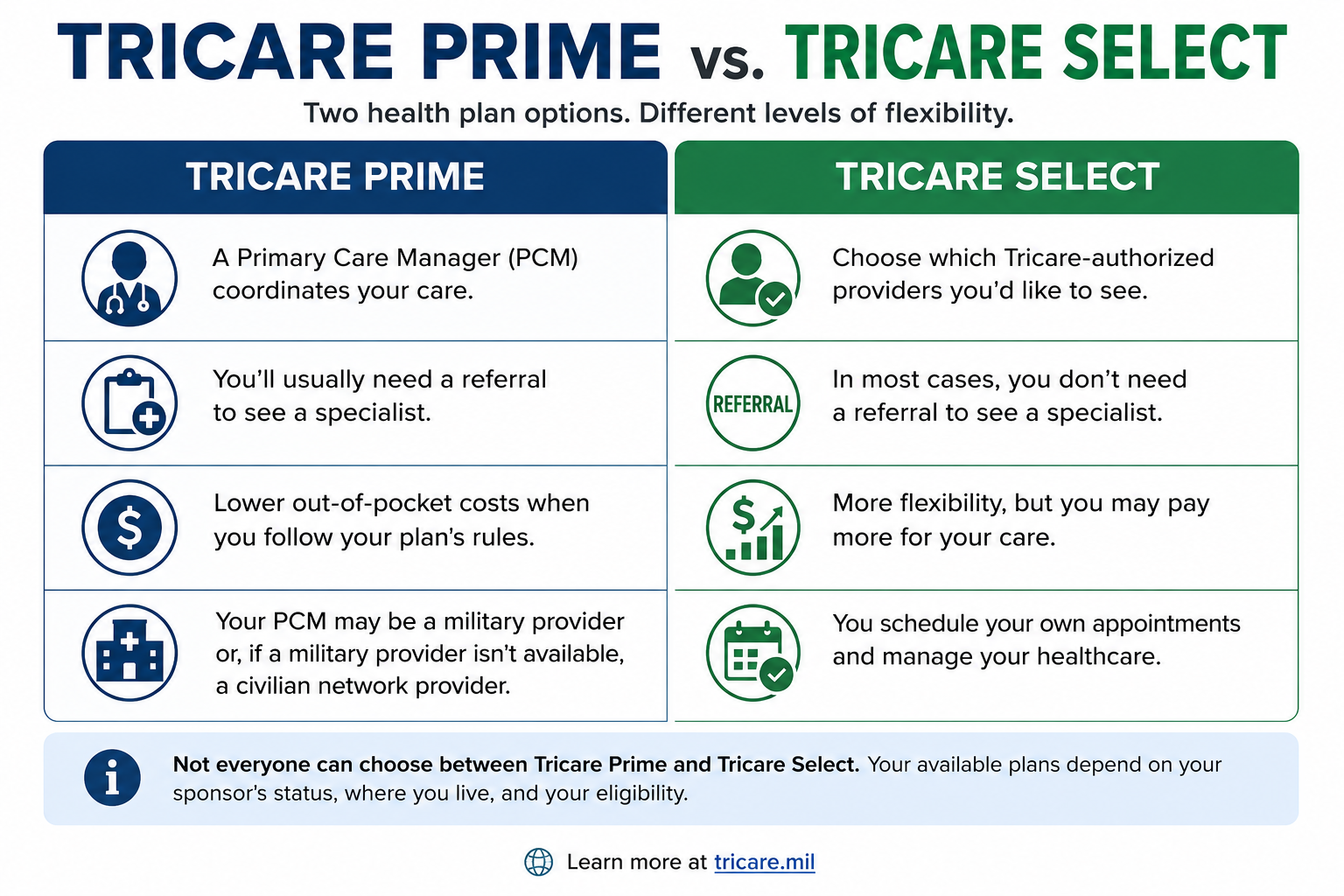
Note: If you live in a designated remote area, you may qualify for Tricare Prime Remote, which works similarly to Tricare Prime but typically uses civilian healthcare providers because military treatment facilities aren't nearby.
TFLCI Tip:If you regularly have difficulty getting appointments or obtaining referrals under Tricare Prime, it may be worth comparing Tricare Select during Open Season or after a Qualifying Life Event (QLE). The added flexibility may be a better fit for some beneficiaries, while others prefer the lower out-of-pocket costs and coordinated care offered by Tricare Prime.
Finding a Doctor
If you have Tricare Prime, your care is coordinated through your Primary Care Manager (PCM). Your PCM will provide most of your routine care and, when needed, coordinate referrals for specialty care. If you have Tricare Select, you have more flexibility to choose from Tricare-authorized providers. In general, choosing a network provider can help lower your out-of-pocket costs compared to using a non-network provider. You can search for military and civilian providers using Tricare's official Find a Doctor tool.
What's the Difference Between a Referral and Prior Authorization?
These two terms often get confused, but they serve different purposes. A referral is when your Primary Care Manager (PCM) or provider sends you to another provider or specialist for care they don't provide. If you have Tricare Prime, you'll usually need a referral before seeing a specialist. A prior authorization is Tricare's approval before certain services, procedures, medications, medical equipment, or other types of care will be covered. Your provider usually requests this approval for you before you receive care. Even if you don't need a referral under Tricare Select, some services still require prior authorization before they're covered. You can learn more on the official Referrals and Pre-Authorizations page.
Understanding Tricare Regions
If you live in the United States (often referred to as CONUS), your Tricare plan is administered by a regional contractor based on where you live. Your regional contractor helps manage provider networks, referrals, prior authorizations, claims, and other customer service needs.
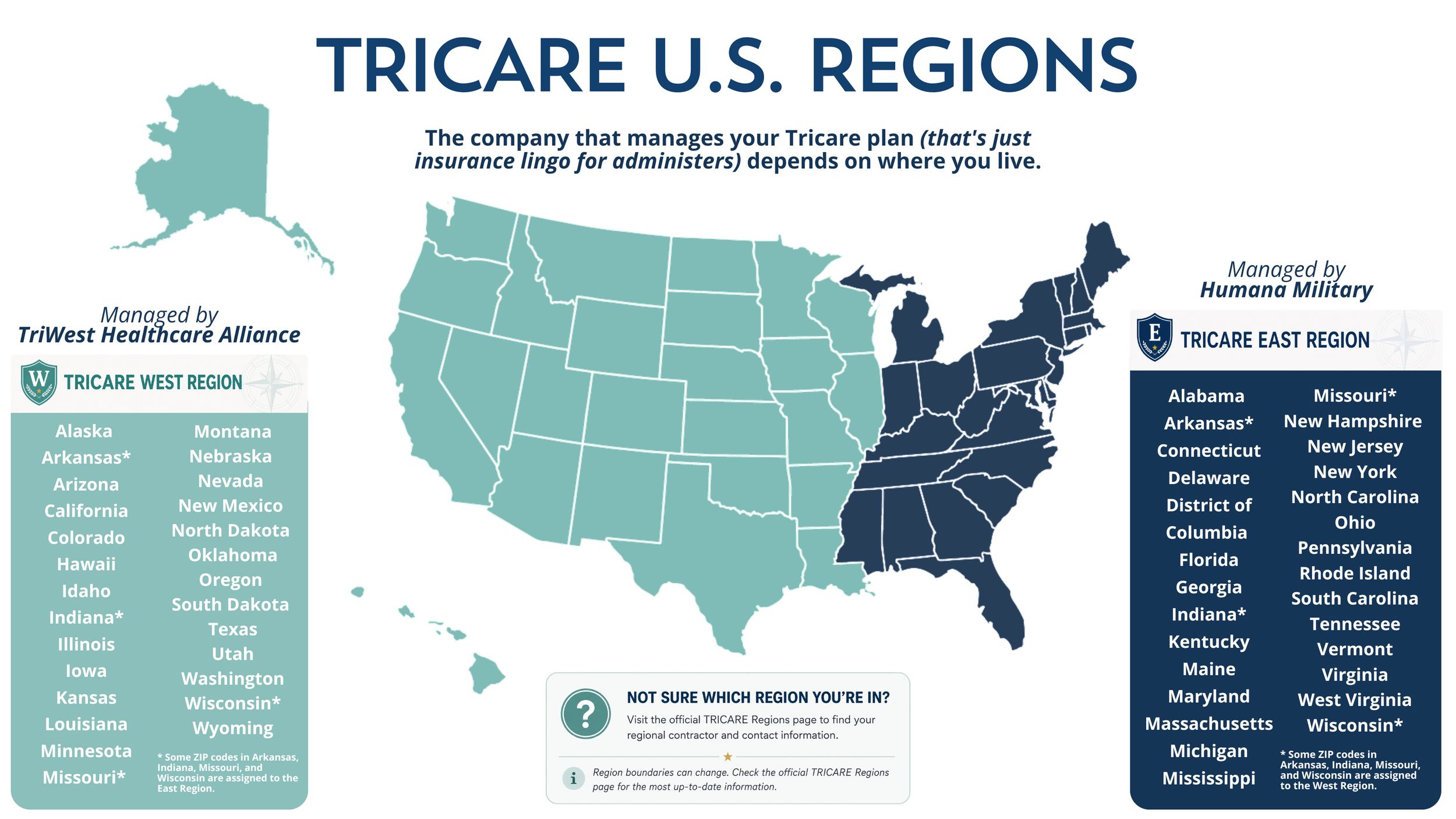
Tricare East
If you live in the East Region, your Tricare benefits are managed by Humana Military. You can find information about network providers, referrals, prior authorizations, claims, and other regional resources on the official Humana Military website.
Tricare West
If you live in the West Region, your Tricare benefits are managed by TriWest Healthcare Alliance. Visit the official TriWest website for information about network providers, referrals, claims, authorizations, and other regional services.
Tricare Overseas
If you're stationed or living outside the United States often referred to as OCONUS, your healthcare is managed through the Tricare Overseas Program (TOP). The Overseas Program has its own network of providers and processes for referrals, authorizations, and claims. If you receive care overseas, it's important to review the guidance for your location before seeking care whenever possible. You can learn more on the official Tricare Overseas Program page.
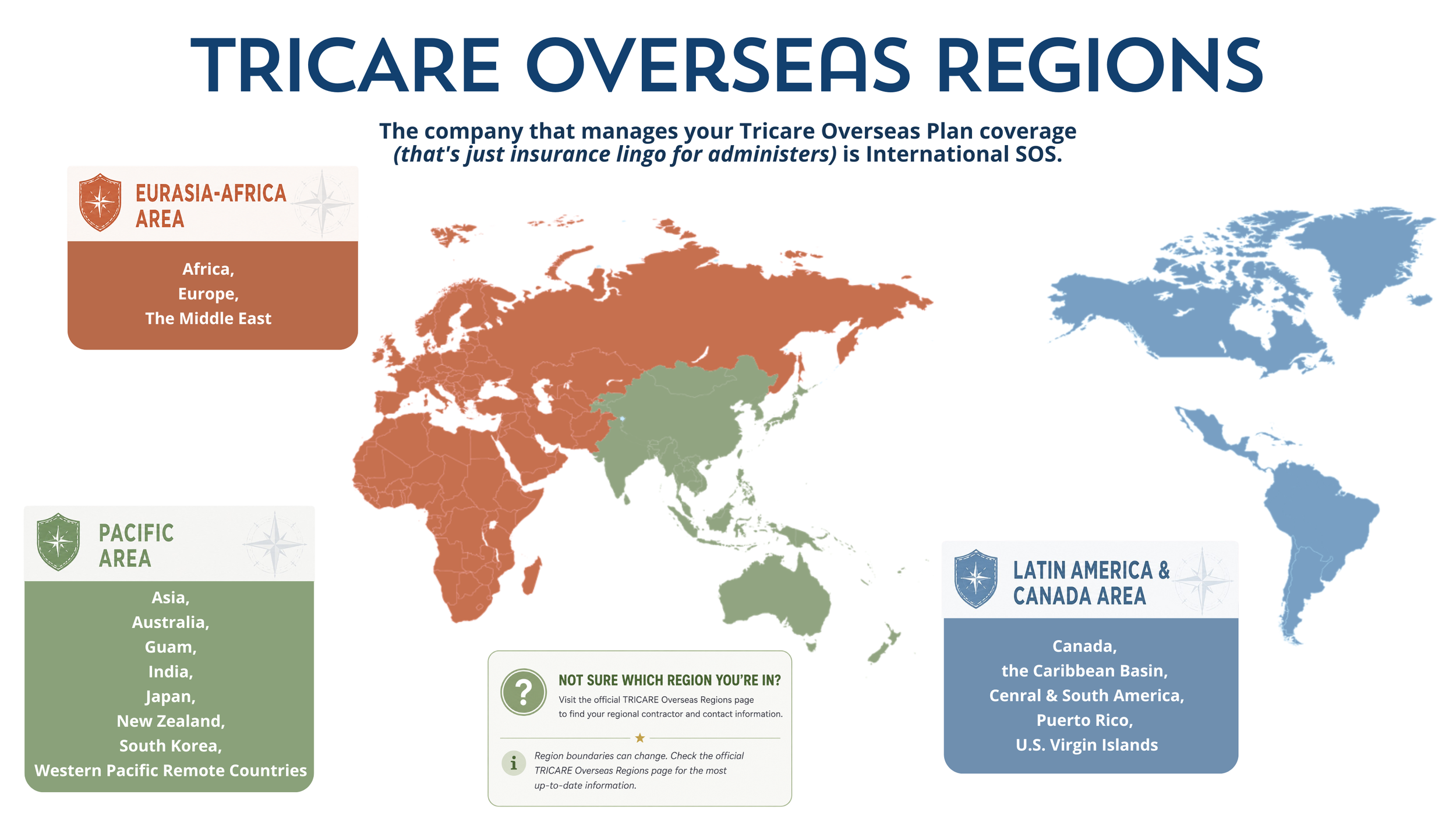
Not sure which region you're in? Visit the official Tricare Regions page to find your regional contractor and contact information.
Prescription Drug Coverage
Both Tricare Prime and Tricare Select include prescription drug coverage through the Tricare Pharmacy Program.
Exception:If you're enrolled in the US Family Health Plan (USFHP), your prescription coverage works differently and is provided through your USFHP plan.
You can fill your prescriptions in several ways:
Military pharmacies – Covered medications are available at no cost, and some military pharmacies may even offer certain over-the-counter medications.
Tricare Pharmacy Home Delivery – Have eligible long-term medications mailed to your home.
Tricare network retail pharmacies – Pick up prescriptions at participating pharmacies like CVS, Walgreens, and many grocery store pharmacies.
Non-network pharmacies – You can still use these pharmacies, but you'll usually pay more and may need to file a claim for reimbursement.
If you take maintenance medications (prescriptions you take regularly), Home Delivery is often one of the most convenient and cost-effective options. To learn more, visit the official Tricare Pharmacy page or manage your prescriptions through Express Scripts.
TFLCI Resource: Looking for more information? Visit our Complete Guide to the Tricare Pharmacy Program for an in-depth explanation of Tricare pharmacy benefits, Express Scripts, Home Delivery, maintenance medications, prior authorizations, specialty medications, Medicare Part B medications, and more.
Understanding Prescription Costs
How much you'll pay for a prescription depends on where you fill it and what type of medication it is. Most prescription medications are placed into a medication category (called a tier). Each tier has a set copayment, which is the amount you'll pay for that medication if a copayment applies. You can use the official Tricare Formulary Search Toolto see which tier your medication is in and what your copayment will be.
If you take a medication on a regular basis (often called a maintenance medication), Tricare Pharmacy Home Delivery can be one of the most affordable options. Eligible medications can often be mailed directly to your home in up to a 90-day supply for a single Home Delivery copayment, instead of paying a copayment each month at a retail pharmacy.
TFLCI Tip: Your Tricare copayment is generally the most you'll pay for a covered prescription at a Tricare network pharmacy—not necessarily what you'll pay every time. Depending on the medication and the pharmacy's negotiated price, some prescriptions (such as certain generic antibiotics) may cost less than your standard copayment. If you've ever wondered why you paid less than expected, that's usually why.
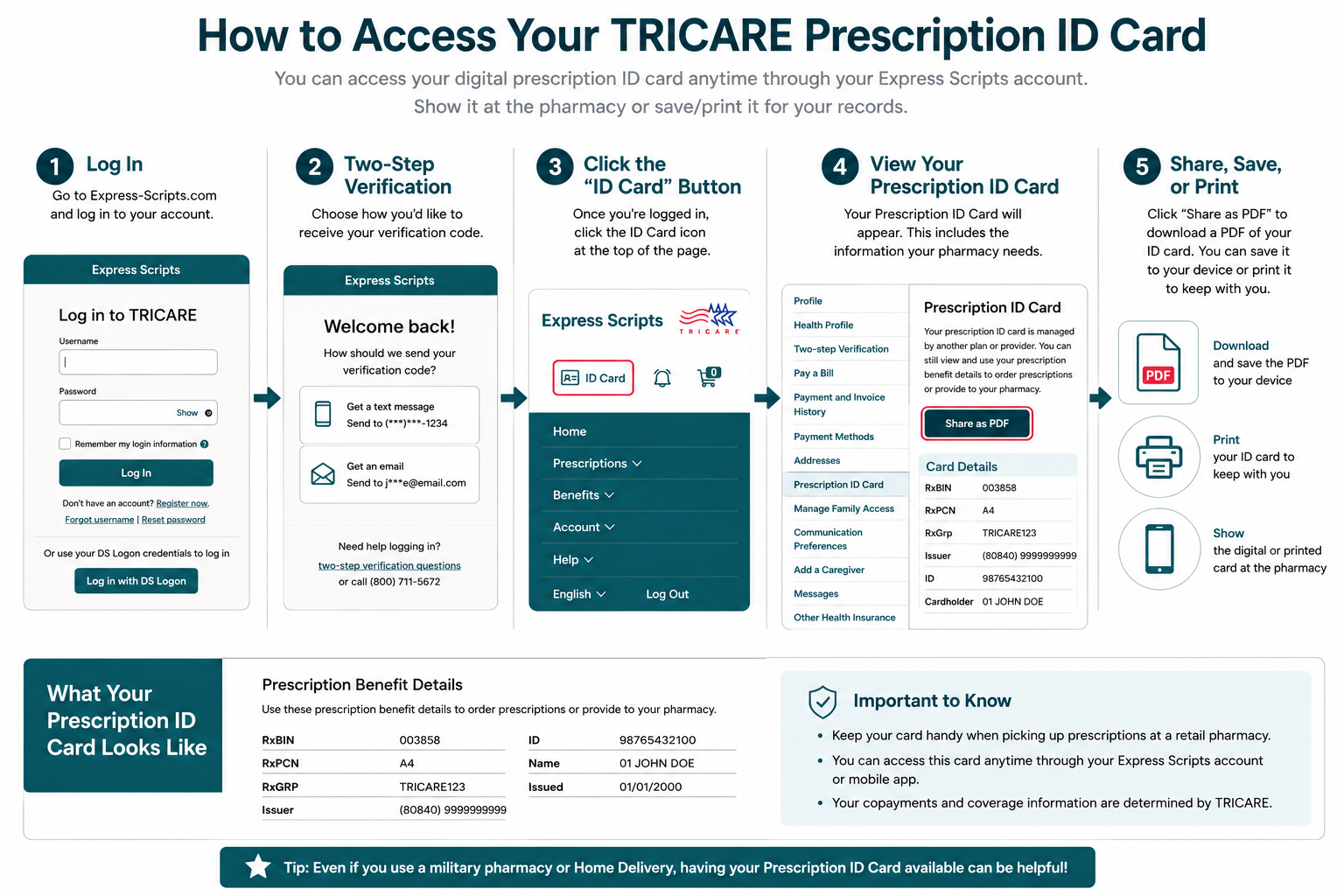
Helpful Tip:You don't have to carry a paper pharmacy card. After creating an Express Scripts account, you can log in anytime to view your digital Tricare Pharmacy ID card and show it at participating retail pharmacies if needed.
What Will I Pay?
Your out-of-pocket costs depend on more than just whether you're enrolled in Tricare Prime or Tricare Select. Other factors can also affect what you'll pay, including:
Whether your service member is on active duty, retired, or in the Reserve Component (Tricare refers to your service member as your sponsor)
Whether you're enrolled in Tricare Prime or Tricare Select
Whether you're in Group A or Group B (if applicable)
The type of care you receive
Whether you receive care from a network or non-network provider
For example:
Active duty service members don't pay out-of-pocket costs for their own covered healthcare.
Active duty family members may have different costs depending on whether they're enrolled in Tricare Prime or Tricare Select.
Retirees and their eligible family members may have enrollment fees, annual deductibles, copayments, or cost-shares.
Reserve Component members and their families enrolled in plans such as Tricare Reserve Select or Tricare Retired Reserve have their own premiums and cost-sharing rules.
Depending on your eligibility and health plan, you may have:
Enrollment fees
Annual deductibles
Copayments
Cost-shares
What are Group A and Group B?
If you're a retiree or an eligible family member, you may see references to Group A and Group B when looking at Tricare costs. These groups help determine certain enrollment fees and out-of-pocket costs. Your group is based on your service member’s initial enlistment or appointment date, not when you enrolled in Tricare or retired from the military. Because Tricare costs can change each year, it's always a good idea to review the current Tricare Costs page before receiving care.
What is a catastrophic cap (maximum out-of-pocket)?
A catastrophic cap is the most you'll pay out of pocket for covered Tricare services in a calendar year. Once you reach your catastrophic cap, Tricare pays 100% of your covered healthcare costs for the rest of that calendar year. The amount of your catastrophic cap varies depending on your beneficiary category and Tricare plan.
TFLCI Tip: If you're enrolled in Tricare Prime or Tricare Select, your annual enrollment fee counts toward your family's catastrophic cap (the most you'll pay out of pocket for covered Tricare healthcare each calendar year). However, monthly or quarterly premiums for plans such as Tricare Reserve Select (TRS), Tricare Retired Reserve (TRR), Tricare Young Adult (TYA), and the Continued Health Care Benefit Program (CHCBP) do not count toward your catastrophic cap.
Do I Have to File Claims?
Usually, no. In most cases, your provider will submit claims directly to Tricare for you. However, if you receive care from a non-network provider or in certain other situations, you may need to file your own claim. Before your appointment, it's always a good idea to ask your provider whether they submit Tricare claims on your behalf. If you ever need to file a claim yourself, you'll find forms and instructions on the official Tricare Claims page.
Managing Your Tricare Benefits
Keeping your information up to date helps make sure your coverage continues without unnecessary delays.
Here are a few helpful resources you'll likely use throughout your Tricare journey:
DEERS – Keep your personal information and eligibility up to date.
milConnect – Manage many of your military benefits online, including enrolling in or changing eligible Tricare health plans during enrollment periods or after a Qualifying Life Event. A Qualifying Life Event is a major life change that allows certain Tricare beneficiaries to enroll in or change their health plan outside of the annual enrollment period. Examples include getting married, having a baby, moving, retiring from active duty, or losing/gaining other health insurance
Dental and Vision Benefits
Dental and vision benefits are separate from your Tricare medical coverage.
Dental care: Routine dental coverage is available through separate dental programs for eligible beneficiaries.
Vision care: If you have an eye injury, eye disease, or another medically necessary eye condition, your care is generally covered under your Tricare health plan. Routine vision care—such as eye exams for glasses or contact lenses—is available only to certain eligible beneficiaries through separate vision benefits.
To learn more about your dental and vision coverage options, visit the official Tricare Dental and Tricare Vision pages.
Need More Help?
Learning how Tricare works can feel overwhelming at first, especially if you've never had military health coverage before. That's exactly why we created the Tricare for Life Care Initiative. Our mission is to help military members, retirees, veterans, and their families better understand their Tricare benefits through free, easy-to-understand educational resources. As our Resource Center continues to grow, we'll keep adding articles that answer the questions military families ask most often.
If you're looking for a place to ask questions, learn from other military families, and stay up to date on Tricare news and changes, we'd love to have you join our Tricare Prime & Select Facebook community.
Related Resources
Understanding Tricare Referrals & Prior Authorizations (Coming Soon)
Using the Tricare Pharmacy Program (Coming Soon)
Understanding Tricare Costs (Coming Soon)
How to File a Tricare Claim (Coming Soon)
Turning 65? Your Tricare For Life Transition Checklist(For beneficiaries approaching age 65 or becoming eligible for Medicare.)
⚠️ Educational Disclaimer
The Tricare For Life Care Initiative (TFLCI) is a 501(c)(3) nonprofit organization dedicated to providing educational information to military retirees, families, and beneficiaries. We are not affiliated with or endorsed by the Department of Defense, Defense Health Agency, TRICARE, Medicare, or the Social Security Administration. Always refer to official government sources or contact the appropriate agency regarding your individual benefits and eligibility.